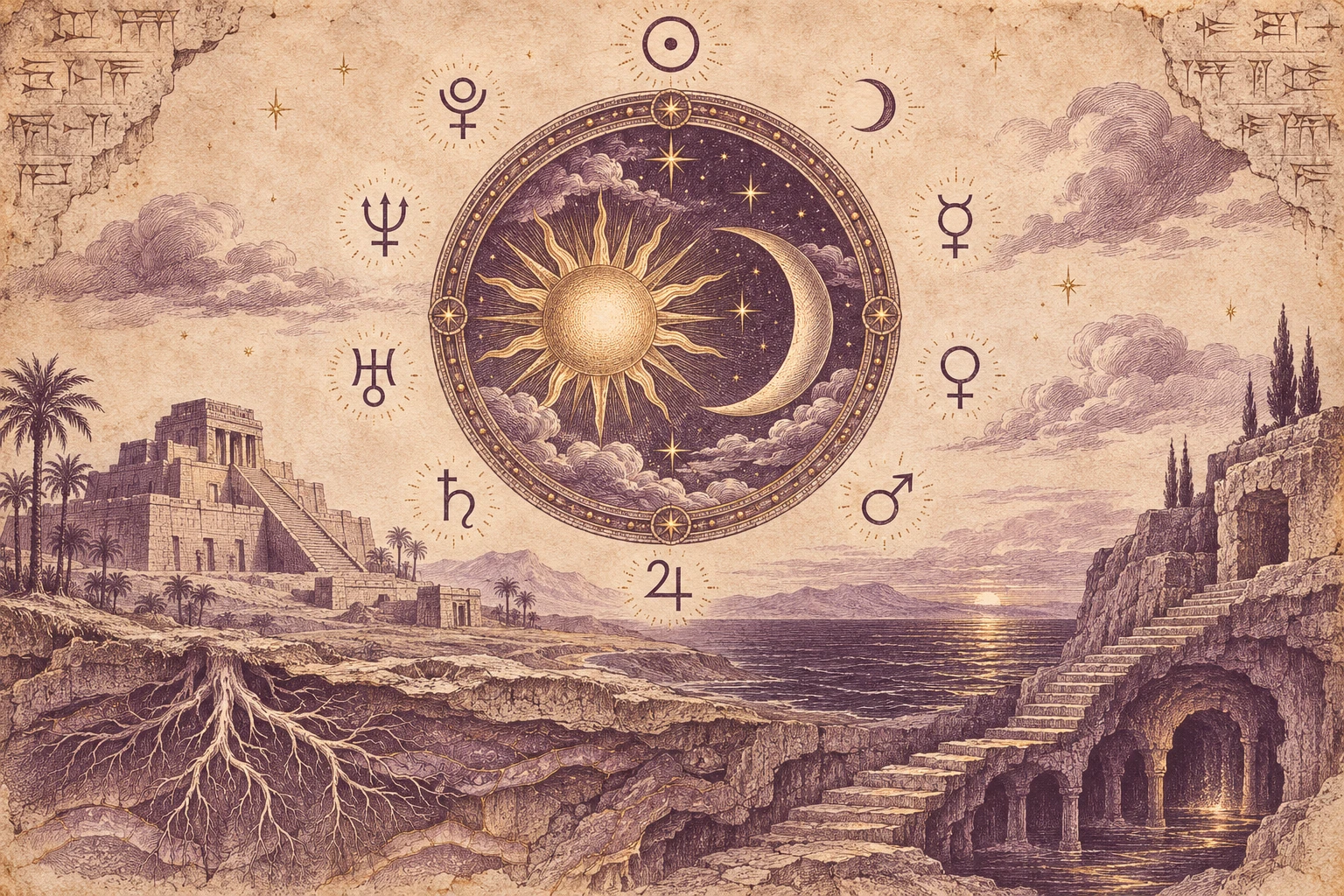
Long before the planets carried their familiar Roman names, they belonged to older sacred stories. In ancient Mesopotamia, the wandering lights were associated with divine powers: Venus with Inanna and Ishtar, Mercury with Nabu, Mars with Nergal, and Jupiter with Marduk. Their movements were observed as signs within a living relationship between heaven and earth.
Across centuries, these celestial traditions traveled and changed. Greek and Roman cultures gave the planetary gods new names and expressions, preserving some associations while reshaping others. The names familiar to Western astrology are one layer of a much longer history. Each deity also belonged to a particular culture, with stories and meanings that cannot be fully translated into another.
Modern psychological astrology brings a further perspective, exploring how planetary images might illuminate human experience. Here, archetype describes a recurring pattern expressed through many stories and circumstances. A planetary figure can embody conflicting qualities: tenderness and possessiveness, wisdom and certainty, courage and aggression.
The question becomes: what does each figure reveal about the complexity of being human?
Reading the planetary language
In astrology, the planets symbolize different functions and motivations. Their signs suggest styles of expression; their houses indicate areas of life where those functions become especially visible. Aspects describe relationships among them, including cooperation, tension, and the work of integration.
The Sun and Moon are included in this language as the two luminaries. Although astronomically distinct from planets, they hold central places in the chart’s symbolic account of vitality, identity, instinct, and belonging.
☉ The Sun · Illumination and authority
Solar symbolism reaches far beyond the familiar image of Apollo. In ancient Mesopotamia, the Sun was associated with Utu, known in Akkadian as Shamash, whose domain included justice. The light that makes things visible also offers an image of discernment: what has been concealed can be brought into view. In Greek tradition, Helios personified the Sun, while Apollo developed solar associations alongside his connections with prophecy, music, and healing.
In modern astrology, the Sun symbolizes vitality, purpose, and the developing sense of self. Its light raises questions about authority as well as expression. What gives a life direction? What deserves sustained energy? The desire to shine can become creative participation, but it can also become dependence on recognition. Solar growth involves learning to inhabit a life with enough confidence to contribute and enough humility to keep learning.
☽ The Moon · Rhythm and belonging
Lunar traditions hold many forms of divinity. The Mesopotamian Moon god Nanna, also known as Sin, reminds readers that the Moon has not always been understood as feminine. Greek traditions offer other expressions through Selene and the lunar associations of Artemis and Hecate. These figures belong to distinct stories, yet together they widen the imaginative territory of the Moon beyond a single image of motherhood.
Astrologically, the Moon describes instinctive responses, emotional needs, memory, and familiar ways of seeking safety. Its changing appearance offers a language for rhythms that cannot remain constant. What nourished a person once may no longer be enough. Lunar awareness includes recognizing the comfort of familiar habits and noticing when those habits keep an old fear alive. Belonging develops through responsiveness to changing needs.
☿ Mercury · Language and passage
Before the Greek Hermes and Roman Mercury, Babylonian tradition associated the planet with Nabu, a deity of writing and wisdom. Hermes brings his own rich mythology: messenger, traveler, trickster, and guide across thresholds. These associations place Mercury wherever something must move between different worlds, whether a message, a trade, an idea, or a soul.
In a chart, Mercury symbolizes perception, learning, thought, and communication. It describes the ways experience becomes language and how language shapes experience in return. Its gifts include curiosity, translation, and the ability to consider another interpretation. Its difficulties include clever evasions and explanations that lose contact with feeling. Mercury asks whether words are helping something become understood or merely making it easier to avoid.
♀ Venus · Desire and sovereignty
Venus’s older Mesopotamian associations introduce a formidable figure. Inanna/Ishtar belonged to the realms of sexual love and warfare, holding desire and power within the same divine presence. Her complexity expands the familiar territory of Aphrodite and Roman Venus. Attraction has consequences; longing can unsettle an established order.
In modern astrology, Venus symbolizes pleasure, relationship, aesthetics, and value. Its territory includes what draws attention, what feels worthy of care, and what is exchanged in the pursuit of connection. Venus can describe the pleasure of mutual affection alongside the temptation to abandon personal values for approval. Its deeper inquiry concerns the relationship between desire and self-possession: how can closeness develop while each person retains a voice?
♂ Mars · Force and protection
The Babylonian association of Mars with Nergal brings themes of war, destruction, and the underworld. Greek Ares and Roman Mars offer different cultural expressions of martial power. Ares often embodies the volatility of battle, while Roman Mars also carries protective and civic significance. The planet’s mythic inheritance contains both the danger of force and the question of what a community entrusts it to defend.
Astrologically, Mars describes initiative, assertion, anger, and the pursuit of desire. It is present in the first step, the necessary refusal, and the willingness to meet resistance. Anger may reveal a crossed boundary, though the feeling alone cannot determine a just response. The development of Mars involves finding proportion and direction, so that energy can serve a meaningful purpose.
♃ Jupiter · Meaning and sovereignty
Jupiter’s planetary ancestry includes Marduk, the chief god of Babylon, followed by associations with Greek Zeus and Roman Jupiter. These are figures of rulership and the ordering of a larger world. Their authority gives Jupiter’s symbolism a wider reach than optimism or good fortune alone: it includes the beliefs and laws through which order is established.
In modern astrology, Jupiter describes growth, faith, generosity, and the search for meaning. It supports the ability to imagine possibilities beyond present circumstances. Yet expansion can become excess, and conviction can harden into entitlement. Jupiter’s development includes examining the reach of a belief: does it enlarge understanding, or does it require every experience to confirm what is already assumed?
♄ Saturn · Limits and continuity
Saturn’s earlier planetary associations include the Mesopotamian deity Ninurta. Greek Kronos and Roman Saturn contribute further stories involving succession, agriculture, and the struggle over authority. Kronos’s fear of being displaced offers a particularly vivid image of power attempting to prevent the future from arriving.
Astrologically, Saturn symbolizes boundaries, responsibility, time, and the structures that make continuity possible. Its challenges can be felt through fear, restriction, or a relentless inner judge. Its gifts develop through practice: skill, reliability, and the ability to carry a commitment through difficulty. Saturn asks which structures support life and which have become defenses against change. Maturity includes the capacity to preserve, revise, and sometimes relinquish.
♅ Uranus · Freedom and disruption
Uranus takes its name from Ouranos, the primordial Greek sky god. The ancient figure and the modern planetary archetype have different histories. Uranus’s astrological associations with innovation, rebellion, and sudden change developed after the planet’s discovery in 1781.
In modern astrology, Uranus symbolizes the impulse to interrupt a pattern and make room for an unforeseen possibility. It can describe liberation, experimentation, and the shock of recognizing that an inherited arrangement is no longer workable. Its difficulties arise when the demand for independence dismisses attachment or consequence. Uranian change asks how freedom can become livable, with enough care for what follows the breakthrough.
♆ Neptune · Longing and dissolution
Neptune bears the name of the Roman sea god, associated with Greek Poseidon. Its modern astrological meanings developed after its discovery in 1846. The ocean supplies a powerful symbolic landscape: immense, beautiful, sustaining, and impossible to hold still.
Astrologically, Neptune describes imagination, compassion, spiritual longing, and experiences in which the boundaries of the self seem to soften. Its sensitivity can nourish art and a profound sense of connection. It can also invite idealization, projection, or escape from painful realities. Neptune’s inquiry concerns the relationship between longing and discernment. A dream becomes more sustaining when there is room to recognize the actual people and circumstances within it.
♇ Pluto · Hidden power and transformation
Pluto takes its name from a ruler of the underworld, associated with Greek Hades and the riches beneath the earth. These ancient stories long predate the discovery of Pluto in 1930 and the development of its modern astrological interpretation. The underworld offers an image of what lies outside ordinary visibility, including what is feared, buried, or held beyond conscious control.
In modern astrology, Pluto symbolizes power, compulsion, survival, and profound change. Its territory includes the strategies developed to withstand vulnerability and the costs of maintaining them. Transformation here may involve recognizing a difficult truth, grieving an ending, or loosening a consuming need for control. Pain does not automatically produce wisdom. Meaning can develop through the care, honesty, and support brought to an encounter with it.
A gathering of voices
No planet speaks alone. The need for closeness may coexist with a strong desire for freedom. Confidence may grow alongside caution. Anger may protect a vulnerability that has yet to find words.
The chart places these motivations in relationship. Its tensions can be explored as conversations among different needs, each carrying a partial truth. Myth gives those conversations characters, images, and stories through which they can be approached with greater curiosity.
Meaning develops through learning how the voices speak to one another, and how a life might give each of them a more conscious expression.