A birth chart is a map of the sky at a particular moment, divided into twelve houses. Each house describes an area of experience: the body, home, relationships, work, friendship, and the private life within.
Planets describe the energies at work. Signs describe how those energies express themselves. Houses describe where they take shape.
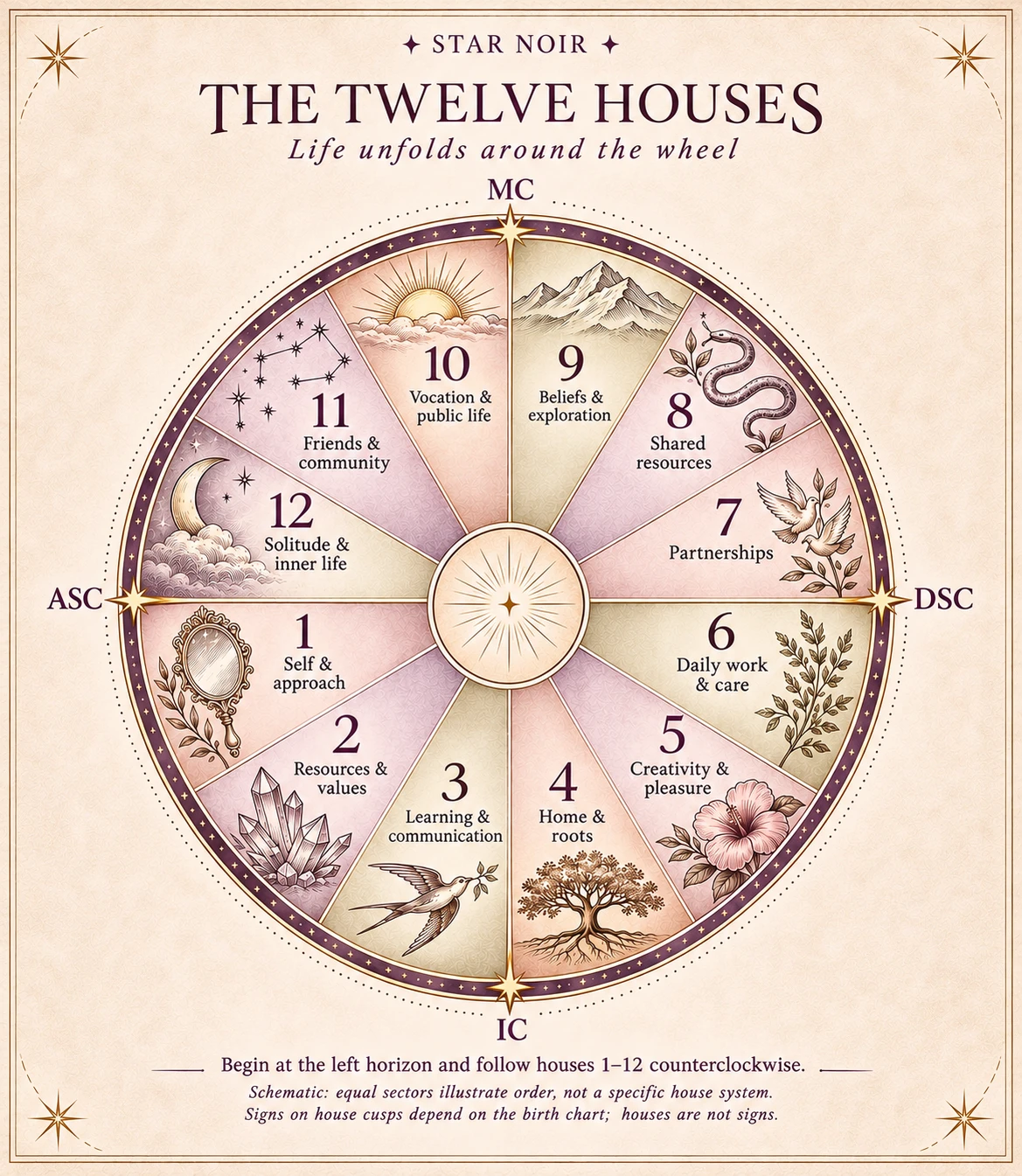
The First House begins at the Ascendant, the eastern horizon. From there, the houses proceed counterclockwise around the chart.
The houses give the sky a place in everyday life.
A journey through the twelve houses
- Self & approachThe way life is first met: presence, embodiment, and the approach to unfamiliar situations. The Ascendant marks the beginning of the First House.
- Resources & valuesPersonal resources, possessions, practical security, and the values that guide the use of time, money, and energy.
- Learning & communicationEveryday thought and conversation, early learning, siblings, neighbors, and the immediate environment.
- Home & rootsPrivate life, ancestry, family patterns, and the foundations that create a sense of belonging.
- Creativity & pleasurePersonal expression, play, romance, children, and the experiences that bring delight.
- Daily work & careRoutines, service, daily responsibilities, and the practical habits involved in caring for the body.
- PartnershipsClose one-to-one relationships, committed partnerships, agreements, and the encounters that reveal another point of view.
- Shared resourcesJoint finances, inheritance, intimacy, trust, loss, and the changes that come through deep involvement with others.
- Beliefs & explorationHigher learning, philosophy, spirituality, travel, and the search for meaning beyond familiar surroundings.
- Vocation & public lifePublic responsibilities, reputation, authority, and the contribution developed over time.
- Friends & communityFriendships, groups, shared hopes, and participation in a larger social world.
- Solitude & inner lifeRetreat, dreams, unconscious patterns, spiritual reflection, and experiences that unfold away from public view.
A conversation across the wheel
Opposite houses describe related experiences: self and partnership (1–7), personal and shared resources (2–8), familiar knowledge and wider understanding (3–9), private roots and public life (4–10), personal creativity and collective participation (5–11), daily care and retreat (6–12).
Reading a house in a birth chart
The sign on a house cusp gives that area of life a particular tone. Its ruling planet adds another thread, while planets within the house bring their own concerns and possibilities. A house without planets still belongs to the chart and remains an active part of life.
The houses are not the signs. Aries does not automatically belong to the First House; the signs on house cusps depend on the individual chart. The wheel shown here uses equal sectors to illustrate the order of the houses, rather than a specific house system.
The angles: four points of orientation
The Ascendant and Descendant mark the eastern and western horizons. They draw a line between the approach to life and the experience of meeting another person. The Midheaven, or MC, speaks to visibility, vocation, and public direction. Its opposite point, the IC, concerns private foundations and roots.
In many quadrant house systems, these four angles begin the First, Fourth, Seventh, and Tenth Houses. In whole-sign and equal-house charts, the MC and IC can fall elsewhere. The angles remain significant even when they do not coincide with those house cusps.
Why house systems differ
Astrologers use several ways to divide a chart into houses. Whole-sign houses assign one complete zodiac sign to each house, beginning with the rising sign. Equal houses use twelve thirty-degree sectors measured from the Ascendant. Quadrant systems divide the chart using the horizon and meridian, often producing houses of different sizes.
The artwork here uses equal sectors to make the sequence easy to follow. It illustrates the houses’ order and themes; it does not reproduce an individual birth chart. An accurate birth time and location matter because the horizon—and the chart’s orientation—changes through the day.
Reading the chart as a whole
A house is a setting, rather than a prediction. Its meaning develops through the sign on its cusp, that sign’s ruling planet, any planets placed within it, and their relationships with the rest of the chart.
Venus in the Third House, for example, may bring attention to beauty in language, affection expressed through conversation, or pleasure in learning. The sign Venus occupies describes its style; its aspects add further complexity. No single placement tells the whole story.
An empty house is not an absent part of life. Its cusp and ruling planet still connect it to the larger chart. Begin with one house, follow those connections, and let the interpretation grow through observation.
A place to begin
Notice the sign on the Ascendant and the planet that rules it. Find the houses occupied by the Sun and Moon. Then consider a familiar area of life—home, partnership, creative expression, or work—and look at the corresponding house.
The purpose is to build a relationship with the chart’s language. The houses offer twelve places to look, each opening onto a different part of lived experience.